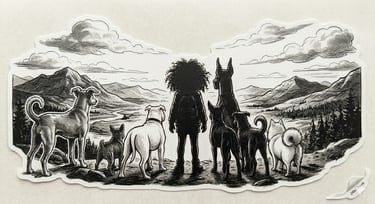
In the opening scene of The Mycelium View from Unanchored, a father stands in a Mussoorie home and justifies what would have felt absurd a generation ago - the need for an installing an air conditioner.
Growing up in Dehradun in the 80s and 90s, summer trips up to Mussoorie meant crisp mountain breeze, misty slopes, pulling out a light sweater by late afternoon, and eating steamed corn. It was a page out of a Brontë novel, not an escape from oppressive heat.
Today, Mussoorie is running out of cold air.
Homes across the Queen of Hills are bolting AC compressors onto balconies. Outside, bumper-to-bumper traffic crawls up / down, idling for hours as exhaust settles into the valley. While the local administration periodically announces tourist pre-registration formalities and entry caps, the ground reality shows cars keep pouring in and gridlocks stretch for 10 kilometres.
Down in the Doon Valley, things aren't much better.
Dehradun’s IT Park and Sahastradhara flood after ordinary monsoon rain. When we were children, the slope used to carry the water away, no matter how hard it rained. Today, thousands of full-grown trees have been cleared for wider highways, replacing the soil’s natural sponge with tiles and concrete. And as forest boundaries blur, wild elephants wander into suburban backyards looking for water and migration paths that disappeared over the years.
In The Mycelium View, Krishna calls this ‘anthropogenic desperation’ - installing the AC creates the exact feedback loop that accelerates the crisis.
While policy panels debate long-term climate repair, the priority must be halting active damage right now. As local voices like Anoop Nautiyal and historian Dr. Lokesh Ohri have spent years documenting, unbridled construction is overwhelming fragile Himalayan geography.
Before we can fix the hills, we have to stop breaking them. There are plenty of proven ideas working elsewhere right now. We can adapt immediate, proven ideas working elsewhere while tailoring them to local realities:
1) Mandate Passive Cooling for New Buildings (The EcoCollab Principle): As built-environment research initiatives like EcoCollab point out, dumping compressor exhaust onto mountain slopes creates localized microclimate heat islands. Municipal building codes in Mussoorie and Dehradun must mandate thermal-efficient design, smart window-to-wall ratios (WWR), mutual shading, insulation, and traditional materials like lime plaster, so new builds keep heat out naturally without overloading the regional grid.
2) Manage the Whole Hydrologic Basin (Adapting the Leeds Blueprint): When Leeds in the UK faced severe urban flooding along the River Aire, they looked upstream, restoring upland soils and planting forests miles away to absorb rainfall before it hit the city. While the steep, young geology of the Shivaliks requires its own engineered erosion controls, the principle is identical, treating Mussoorie’s slopes and Dehradun’s valley as the upper catchment of the valley's watershed means protecting upper forest cover to directly stop IT Park from turning into a lake during every monsoon.
3) Enforce Real Entry Caps (The Sikkim/Venice Model): Forms don't stop traffic jams, physical barriers do. Following models used in Sikkim or Venice, automated checkpoints at Kothal Gate could track parking availability in real time. Once Mussoorie’s off-street parking fills up, private tourist vehicles get redirected to park-and-ride hubs in the lower valley.
4) Stop Plastic at Valley Checkpoints (The Nilgiris Model): Taking a page from Tamil Nadu’s Nilgiris district, strict physical checkpoints at entry routes can audit incoming commercial and tourist vehicles to intercept single-use plastics before they choke the valley's drainage.
5) Create Pedestrian Zones (Adapting the Matheran Model): While Mussoorie cannot ban vehicles entirely like Matheran because it serves as a transit route for regional and national highways, it can ring-fence its core commercial and heritage hubs. Local bypasses can carry essential through-traffic, while internal transit relies on electric shuttles driven and operated by local taxi unions, protecting livelihoods while cutting gridlock.
6) Pause Unstable Hill-Cutting: Cutting deeply into fragile Himalayan rock for multi-lane highways triggers the massive landslides now common on the Dehradun-Mussoorie route. Major slope alteration needs an immediate pause until local carrying capacity and hyper-local geological safety audits are actually completed.
7) Back Rules with Real Teeth: Naturally, none of these policies work without heavy penalties for defaulters, whether it is illegal hill-cutting, plastic dumping, bypassing entry caps, or even jumping the queues by driving on the wrong side.
That AC humming on a Mussoorie balcony is an alarm bell that our mountain buffer has run out. Halting the damage doesn't take endless debates. It takes action that treats Himalayan terrain with a bit of common sense. And each one of us has to do our bit.